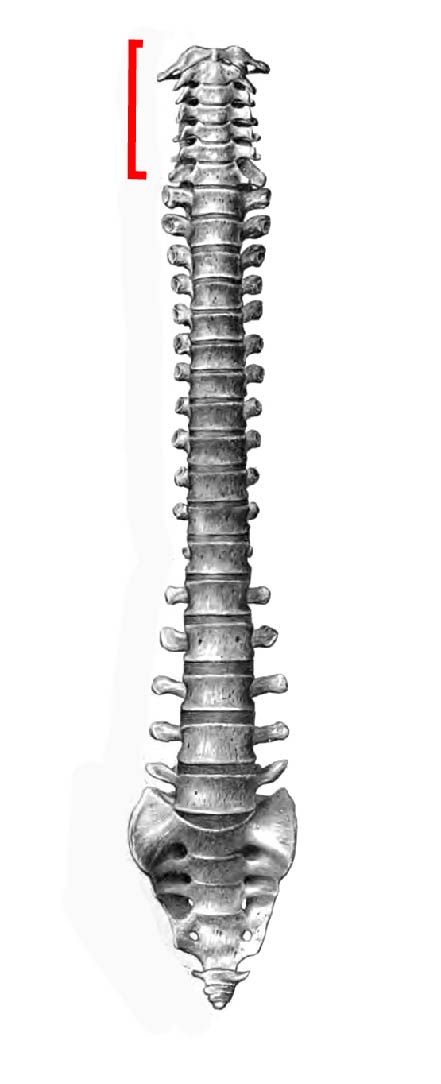
The cervical vertebrae are the seven bones that form the skeletal framework of the neck, supporting and protecting the spinal cord while enabling head movement. They are uniquely designed with transverse foramina for vertebral artery passage and are generally smaller and more mobile than other vertebrae. The first two cervical vertebrae (atlas and axis) are specially modified to allow for the complex movements of the head, including nodding and rotation.
The term "cervical" comes from the Latin word "cervix" meaning neck. "Vertebrae" is derived from the Latin vertere, meaning "to turn," referring to their role in movement.
Image